Choosing an irrigation system is one of the biggest long-term decisions on a farm. It affects water use, labor, energy bills, fertilizer efficiency and ultimately yield. This guide compares the three most common types of irrigation systems – drip irrigation, sprinkler irrigation and flood (surface) irrigation – so you can decide what fits your crops, soil and budget.
Quick comparison
| Drip | Sprinkler | Flood / Surface | |
|---|---|---|---|
| Typical water efficiency | Highest (often around 90%) | Medium–high (often 70–85%) | Lowest (often 40–60%) |
| Upfront cost | High | Medium | Low |
| Labor | Low once installed | Low–medium | High |
| Best crops | Row crops, vegetables, orchards, sugarcane, cotton | Closely spaced crops: wheat, pulses, groundnut, fodder, lawns | Rice, crops on level heavy soils |
| Fertigation | Excellent | Possible | Poor |
| Land levelling needed | No | No | Yes |
Efficiency figures are typical ranges; real performance depends heavily on design, maintenance and management.
Drip irrigation
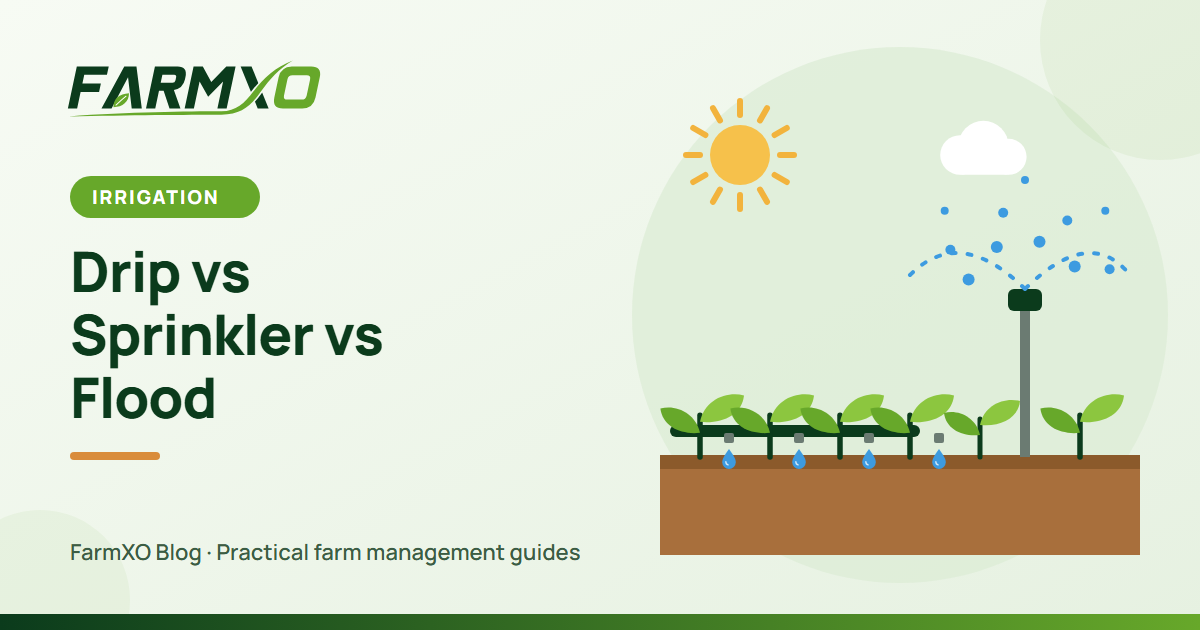
Drip irrigation delivers water slowly, directly to the root zone through pipes and emitters. Because little water is lost to evaporation or runoff, it is the most water-efficient option.
Advantages
- Large water savings compared to flood irrigation
- Fertigation – applying fertilizer through the drip system – improves nutrient use and saves labor
- Dry rows between plants mean fewer weeds and less foliar disease
- Works on uneven land and light soils
Disadvantages
- Highest upfront cost, though many governments offer micro-irrigation subsidies
- Emitters can clog – it needs filtration and regular flushing
- Laterals can be damaged by rodents, machinery and workers
Sprinkler irrigation
Sprinklers spray water over the crop like rainfall. Systems range from portable pipes to centre pivots and rain guns.
Advantages
- Suits closely spaced crops where drip lines are impractical
- No land levelling needed; good for sandy and undulating land
- Can provide frost protection and cooling in some crops
Disadvantages
- Wind and high temperatures increase evaporation and cause uneven coverage
- Wet foliage can increase some leaf diseases
- Needs reliable pressure and power
Flood (surface) irrigation
Water flows over the field by gravity through basins, borders or furrows. It is the oldest and still the most widespread method.
Advantages
- Lowest equipment cost and simple to operate
- Suits rice and other crops that tolerate standing water
Disadvantages
- Large losses to runoff and deep percolation
- Uneven application unless land is well levelled
- Can leach nutrients and raise water tables, leading to salinity over time
Tip: if you stay with surface irrigation, laser land levelling, furrow or alternate-furrow irrigation and shorter field runs can noticeably improve efficiency.
How to choose the right irrigation system
- Water availability: where water is scarce or expensive to pump, drip usually pays back fastest.
- Crop type and spacing: wide-row and high-value crops favour drip; dense field crops favour sprinklers.
- Soil: sandy soils lose water quickly under flooding – drip or sprinklers are better.
- Budget and subsidies: check local micro-irrigation subsidy schemes before ruling drip out.
- Labor and power: pressurised systems need reliable electricity but save labor.
Whatever the system, schedule it well
Even the best system wastes water if it runs at the wrong time. Pair your system with good irrigation scheduling and track every irrigation in AgriFarm irrigation management to see actual water use per field.
Frequently asked questions
Is drip irrigation worth it for small farms?
Often yes, especially for vegetables, fruit and other high-value crops, and where subsidies reduce the upfront cost. Water, fertilizer and labor savings typically add up quickly.
Can I use drip irrigation for rice?
Drip is being trialled for rice, mainly aerobic or direct-seeded systems, but flooded paddies remain the norm. Alternate wetting and drying is a practical water-saving option for puddled rice.