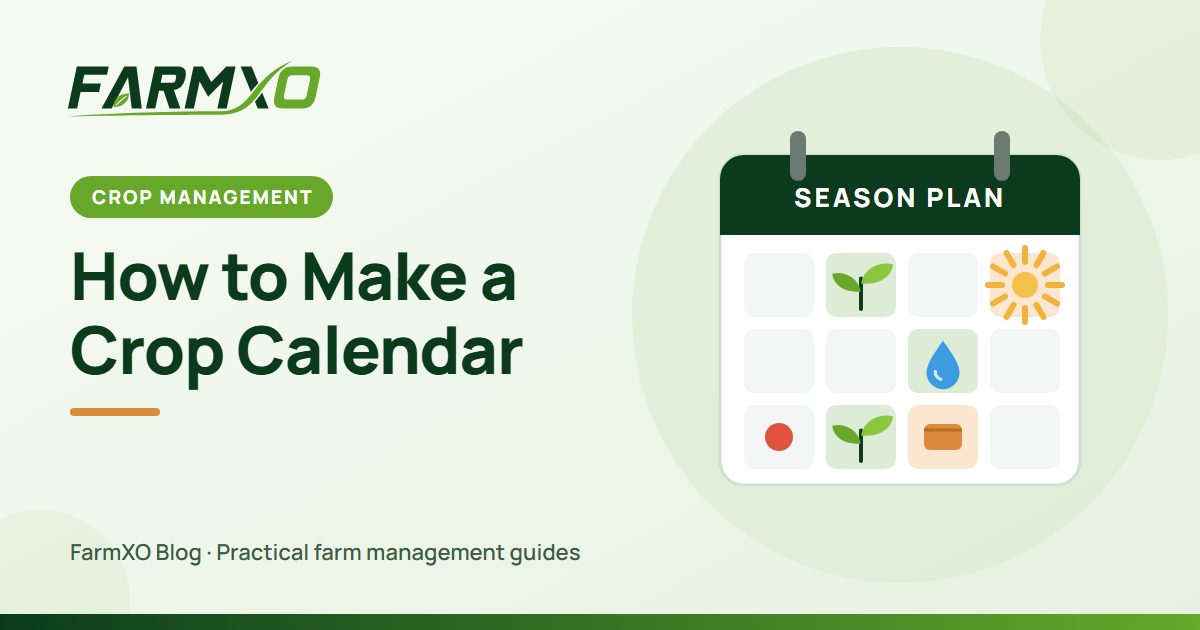
A crop calendar is a schedule that shows when each crop on your farm should be sown, managed and harvested. It turns a season's plan into dates – so seed is bought in time, labor is available when needed, and no field sits idle longer than necessary.
Why every farm needs a crop calendar
- Timely sowing. Sowing outside the recommended window is one of the most common causes of lower yields.
- Input planning. Knowing when fertilizer and chemicals will be needed lets you buy before prices or shortages hit.
- Labor and machinery planning. Peaks like sowing and harvest can be spread out instead of colliding.
- Better rotations. A calendar shows exactly when a field becomes free for the next crop.
Understanding crop seasons: kharif, rabi and zaid
In India and much of South Asia, crops are grouped into three seasons. Exact dates vary by state, rainfall and variety, so always check your local agricultural university or extension recommendations.
| Season | Typical sowing | Typical harvest | Example crops |
|---|---|---|---|
| Kharif (monsoon) | June – July, with monsoon onset | September – October | Rice, maize, cotton, soybean, groundnut, pigeon pea, millets |
| Rabi (winter) | October – December | March – April | Wheat, chickpea, mustard, barley, lentil, peas |
| Zaid (summer) | March – April | May – June | Watermelon, muskmelon, cucumber, moong, fodder crops |
Outside South Asia the same idea applies – spring, summer and autumn plantings – driven by frost dates in temperate regions and rainfall in the tropics.
How to make a crop calendar in 6 steps
- List your fields and crops for the season. Note the variety, because duration varies – a short-duration rice may be ready weeks earlier than a long-duration one.
- Fix the sowing date. Use the recommended window for your region and variety, adjusted for rainfall or irrigation availability.
- Count forward the crop stages. Using the variety's duration, mark key stages: germination, vegetative growth, flowering, grain fill and maturity.
- Attach operations to stages. Basal fertilizer at sowing, top dressing at specific growth stages, irrigation at critical stages, scouting for pests at regular intervals, and harvest at maturity.
- Add preparation tasks before sowing. Land preparation, soil testing, seed purchase and seed treatment.
- Check for clashes. Look for weeks where multiple fields need labor or the same machine. Stagger sowing dates where possible.
Example: simplified wheat calendar (rabi)
- Mid-October: land preparation, soil test, pre-sowing irrigation if needed
- Early to mid-November: sowing with basal fertilizer
- About 3 weeks after sowing: first irrigation at crown root initiation – one of the most critical irrigations for wheat
- 4–6 weeks: weed control and nitrogen top dressing
- Tillering, jointing, flowering and grain filling: irrigation at each critical stage as water allows
- March – April: harvest at physiological maturity
Treat this as an illustration only; use your local variety recommendations for exact timings and doses.
Tips for a crop calendar that works
- Keep one calendar for the whole farm, not one per person.
- Turn every calendar entry into a task with an owner and a due date.
- Record the actual dates next to the planned ones – the gap tells you where planning needs to improve.
- Link it to irrigation scheduling and weather forecasts.
From calendar to action
AgriFarm's crop calendar shows every crop's stages across all your fields and turns planned operations into tasks for your team. Learn more about crop management in AgriFarm, or follow the full lifecycle in tracking crops from planning to sale.
Frequently asked questions
What is the difference between kharif and rabi crops?
Kharif crops are sown at the start of the monsoon and depend on rainfall and warm temperatures; rabi crops are sown after the monsoon and grow through the cooler winter, usually with irrigation.
Can I use one crop calendar every year?
Use it as a template, but adjust it each season for rainfall, variety changes and your rotation plan.